김은지 · Kim Eun-ji
Survivor of digital abuse
Korea · East Asia (Korea) · 26세
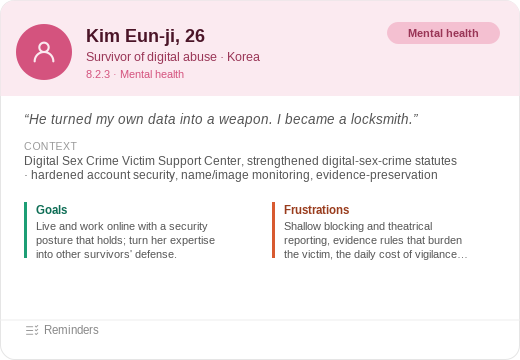
He turned my own data into a weapon. I became a locksmith.
목표
Live and work online with a security posture that holds; turn her expertise into other survivors' defense.
불편 사항
Shallow blocking and theatrical reporting, evidence rules that burden the victim, the daily cost of vigilance.
프로필
Kim Eun-ji is a survivor of digital sexual abuse and cyberstalking by a former partner during university. She experienced threats to distribute illicit recordings, identity misuse, and online harassment. She now works as a web developer and is extremely sensitive about digital safety and privacy. She volunteers with an organization supporting victims of digital sex crimes.
기술 환경
- Hardened security: 2FA on all accounts, regular password changes
- Monitoring: search alerts set for her name/images
- Legal tools: evidence-collection app, lawyer contacts
- Support network: victim-support app, emergency-report shortcut
일상 시나리오
Wednesday morning, as soon as she arrives at work, Eun-ji begins monitoring her 'digital footprint,' entering her name and old usernames into search engines. Confirming there are no new results, she feels relieved.
At work, a notification announces a new teammate has been added to company Slack. She zooms in on the profile photo to check it and searches the name. She knows it's excessive vigilance, but without confirming safety she feels anxious.
// Eun-ji's digital-safety protocol
const digitalSafetyProtocol = {
  dailyRoutine: {
    morning: ['check_name_alerts', 'scan_image_search', 'review_login_attempts', 'verify_privacy_settings'],
    socialMedia: { profiles: 'all_private', friendRequests: 'manual_verification', photoTags: 'approval_required', locationData: 'always_disabled' }
  },
  threatResponse: {
    level1: { trigger: 'suspicious_contact', action: 'block_and_document' },
    level2: { trigger: 'direct_threat', action: 'police_report_template' },
    level3: { trigger: 'content_distribution', action: 'emergency_legal_contact' }
  },
  evidenceCollection: { screenshots: 'timestamped_and_hashed', messages: 'full_header_preservation', backup: 'encrypted_cloud_and_local', legal: 'chain_of_custody_maintained' },
  supportSystem: { trustedContacts: ['lawyer', 'counselor', 'support_group'], panicButton: 'sends_location_to_trusted', checkIn: 'daily_safety_confirmation' }
};
At lunch, Eun-ji joins an online support group for victims of digital sex crimes. Someone asks for help: "The perpetrator contacted me again from a new account." Drawing on her own experience, Eun-ji explains in detail how to collect evidence and the reporting procedure.
In the afternoon, an email arrives from an unknown sender. The subject looks ordinary, but Eun-ji is instantly wary. She analyzes the sender address and runs a virus scan before opening it. When it turns out to be spam she's relieved, but struggles to focus for a while.
After work, Eun-ji has a date with someone she recently met. Before meeting, she thoroughly researches his social media, checking public information for any warning signs. She shares the meeting place and time with a friend and promises to send a safety check-in text partway through.
과제 및 전략
- Constant vigilance: she feels extreme stress even in routine online activity. Eun-ji limits herself to a 'safety check' only at set times.
- Difficulty rebuilding trust: forming new relationships is very hard. She practices building trust slowly and in stages.
- Re-experiencing trauma: a similar situation or word alone can revive fear. She uses EMDR therapy along with a trauma-response app.
- Limits of legal recourse: she's worn down by the complexity of digital evidence-gathering and legal procedures. She builds a network of experts for support.
설계 시사점
- Strong blocking: complete blocking and access-restriction options.
- Evidence-preservation tools: collect legally valid evidence.
- Anonymous reporting: channels to report without revealing identity.
- Victim-centered design: processes that prevent revictimization.