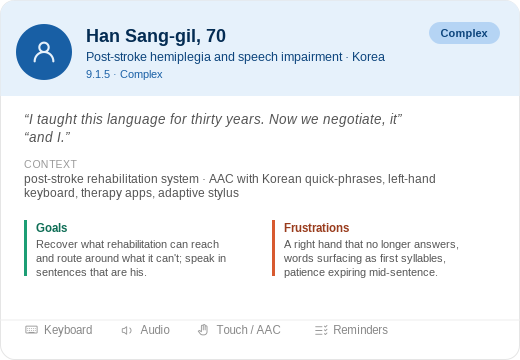
한상길 · Han Sang-gil
Post-stroke hemiplegia and speech impairment
Korea · East Asia (Korea) · 70세
- 관련 법률
- 장차법 · KWCAG 2.2
- 서비스
- 정부24 / 카카오·토스
- 메시징
- KakaoTalk
재활보조공학
- Keyboard
- Audio
- Touch / AAC
- Reminders
I taught this language for thirty years. Now we negotiate, it and I.
목표
Recover what rehabilitation can reach and route around what it can't; speak in sentences that are his.
불편 사항
A right hand that no longer answers, words surfacing as first syllables, patience expiring mid-sentence.
프로필
Han Sang-gil has right-side hemiplegia and Broca's aphasia from a stroke a year ago. A retired high-school Korean-language teacher, he knows clearly what he wants to say but struggles to express it in words, and unable to use his right hand, he must do everything left-handed. Alongside rehabilitation, he actively uses digital tools to communicate with family.
기술 환경
- Communication: AAC app, text-to-speech
- Input: left-handed special keyboard, voice recognition (limited)
- Rehabilitation: speech-therapy app, exercise-guide videos
- Assistive devices: tablet stand, adaptive stylus
일상 시나리오
During morning rehab, Sang-gil runs a speech-therapy app. Seeing an apple on screen, he tries to say "apple" but only "a… a…" comes out. Frustration wells up, but the app shows an encouraging message and prompts him to try again.
// An integrated AAC and rehab system for Sang-gil
const aphasiaRehabSystem = {
  communication: {
    quickPhrases: [
      { icon: '💧', text: 'Water, please', audio: 'water_please.mp3' },
      { icon: '🚻', text: 'I need the bathroom', audio: 'bathroom.mp3' },
      { icon: '💊', text: "It's time for my medicine", audio: 'medicine_time.mp3' },
      { icon: '❤️', text: 'I love you', audio: 'i_love_you.mp3' }
    ],
    wordPrediction: { enabled: true, learningMode: true, contextAware: true },
    multimodal: { gesture: true, facial: true, pictogram: true }   // left-hand gestures, facial expression, pictograms
  },
  rehabilitation: {
    speechTherapy: { difficulty: 'adaptive', feedback: 'encouraging', progress: 'visual' },
    motorSkills: { leftHandOnly: true, exercises: ['virtual_keyboard', 'drag_drop', 'tap_timing'], gamification: true }
  }
};
When he wants to talk with family, Sang-gil uses the AAC app. Frequent sentences are saved in favorites; selecting "How's the weather today?" plays a pre-recorded voice. But spontaneous conversation is still hard—selecting letters one at a time with his left hand takes a long time.
After dinner, Sang-gil tries to write in a journal. He once commanded fluent prose, but now even recalling a word is hard. He tries voice recognition, but it can't properly catch his unclear speech. In the end he uses a picture-diary app to express the day's events with emoji and photos.
과제 및 전략
- Dual language-and-motor impairment: both speaking and typing by hand are hard. Sang-gil practices alternative input methods like blinking and head nods.
- Slow communication speed: completing a sentence takes minutes, and conversation partners find waiting hard. He combines prepared sentences with on-the-spot input.
- Identity confusion: as a former language teacher, the reality of not recalling simple words brings depression. He finds comfort and information in an online aphasia community.
설계 시사점
- Varied input modes: combined support for touch, scanning, gaze, and voice.
- Prediction and autocomplete: context-based word/sentence prediction.
- Non-verbal communication support: expression through facial expression and gesture.
- Integrate rehab and daily life: design connecting therapy with real-world use.