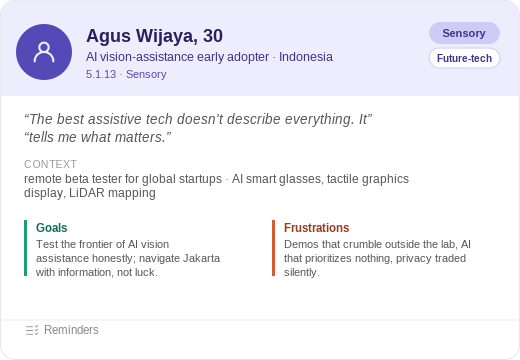
Agus Wijaya
AI vision-assistance early adopter
Indonesia · Southeast Asia · Age 30
- Law
- Law No. 8/2016 on PWD
- Services
- Gojek / OVO ecosystem
- Messaging
Assistive Technology
- Reminders
The best assistive tech doesn't describe everything. It tells me what matters.
Goals
Test the frontier of AI vision assistance honestly; navigate Jakarta with information, not luck.
Frustrations
Demos that crumble outside the lab, AI that prioritizes nothing, privacy traded silently.
Profile
Agus Wijaya is a tech blogger who became totally blind in adulthood, and he's first in line to test and review the newest AI-based vision-assistance technology. He works as a beta tester for startups and experiences the future of accessibility technology firsthand. His YouTube channel, "Agus's AI Eyes," has 100,000 subscribers.
Technology Environment
- AI smart glasses: real-time scene description, text reading, face recognition
- Multi-pin tactile display: converts graphs and images to touch
- AI assistant: GPT-based personalized interpretation of visual information
- Spatial awareness: 3D mapping with LiDAR sensors
Daily Scenario
Wednesday morning, Agus tests his newly received AI smart glasses, "Vision AI Pro." Walking through the living room he asks, "What's in front of me?" and the AI answers at once: "Two meters ahead is a gray sofa with two red cushions on it. To the left of the sofa there's a tall plant."
// Example scene-analysis output from Vision AI Pro
{
  "scene_description": {
    "overview": "Living room, warm afternoon light",
    "objects": [
      {
        "name": "sofa",
        "distance": "2m",
        "direction": "12 o'clock",
        "color": "gray",
        "details": "3-seater, fabric"
      },
      {
        "name": "coffee table",
        "distance": "1.5m",
        "direction": "11 o'clock",
        "status": "a mug and a book on top"
      }
    ],
    "people": "none",
    "lighting": "natural, bright",
    "navigation_hints": "clear path ahead, no obstacles"
  }
}
In the afternoon he reviews a new tactile graphic display. Its 2,400 pins refresh every 0.1 seconds, conveying graphs and images by touch in real time. Feeling a stock chart with his fingertips, Agus marvels: "Blind people can now 'see' real-time data visualization."
On an evening walk, the glasses suddenly warn: "Caution, a construction zone five meters ahead. The detour is to the right, at 2 o'clock." At the same time, turn-by-turn guidance continues through the glasses' bone-conduction speaker.
Future Impact
- Real-time environment awareness: the AI continuously analyzes the surroundings and relays only the relevant parts—no information overload, just what's needed.
- Personalized interpretation: the AI learns Agus's preferences and offers tailored descriptions like "This shirt is the navy you like."
- Predictive support: aware of his schedule and location, the AI prompts proactively—"You have a meeting in 10 minutes. The third-floor room is about 5 minutes away by elevator."
Design Implications
- AI ethics: provide useful information while protecting privacy.
- Information priority: automatically judge what matters by context.
- Multisensory integration: let the AI choose the best sensory channel to deliver information.
- Learning and adaptation: learn user patterns and keep improving.