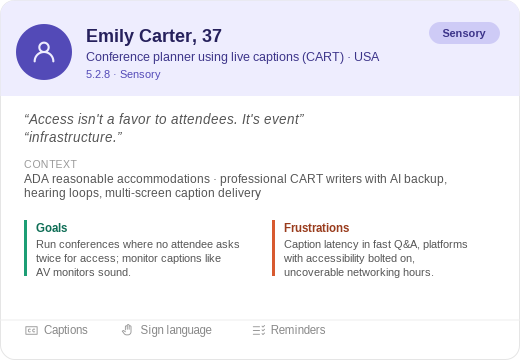
Emily Carter
Conference planner using live captions (CART)
USA · North America · Age 37
- Law
- ADA · Section 508
- Services
- Login.gov / state portals
- Messaging
- iMessage · WhatsApp
Assistive Technology
- Captions
- Sign language
- Reminders
Access isn't a favor to attendees. It's event infrastructure.
Goals
Run conferences where no attendee asks twice for access; monitor captions like AV monitors sound.
Frustrations
Caption latency in fast Q&A, platforms with accessibility bolted on, uncoverable networking hours.
Profile
Emily Carter has profound hearing loss; she wears hearing aids but can't communicate by audio alone. She works as an international conference planner and is responsible for event accessibility. She makes full use of CART (live text interpreting) and works to ensure every attendee has equal access to information.
Technology Environment
- CART service: professional stenographers, AI-caption backup
- Interpreting: sign-language interpreting, multilingual captions
- Personal gear: a caption-receiving tablet, vibration alerts
- Platforms: video-conferencing tools with strong accessibility features
Daily Scenario
In a prep meeting for a large tech conference, Emily joins by video. The screen shows the presenter, the sign-language interpreter, and live captions all at once. She adjusts the layout to make the captions the largest element.
// The accessible-conference system Emily designed
const accessibleConferenceSetup = {
  captioning: {
    providers: ['professional CART stenographer', 'AI backup captions'],
    languages: ['English', 'Spanish', 'Mandarin'],
    display: {
      mainScreen: 'large screens on both sides of the stage',
      personalDevice: 'personal tablet/phone',
      webStream: 'separate caption channel'
    },
    quality: {
      accuracy: '98%+',
      latency: 'under 3 seconds',
      formatting: 'speaker labels, paragraph breaks'
    }
  },
  signLanguage: {
    interpreters: ['ASL', 'International Sign'],
    placement: 'picture-in-picture or separate screen',
    scheduling: 'rotate every 20 minutes'
  },
  audioEnhancement: {
    hearingLoop: 'installed throughout the hall',
    fmSystem: 'individual receivers provided',
    quietZone: 'a sensory rest space'
  }
};
On the day, Emily monitors caption quality in real time from the CART station. When a technical term is mistranscribed, she flags it to the stenographer immediately, while also responding quickly to attendees' accessibility questions.
Networking time is the most challenging. Free-flowing conversation is hard to caption with CART. Emily uses a speech-to-text app and asks attendees to speak slowly and clearly.
Challenges & Strategies
- Limits of real time: captions lag the speech by 2–3 seconds, making interaction hard. Emily confirms important decisions in writing.
- Technical failures: an internet problem or equipment fault is critical. She always has a backup system ready.
- Cost and resources: high-quality CART is expensive. She combines AI captions and human stenography efficiently.
Design Implications
- Layered accessibility: varied options—captions, sign language, audio amplification.
- Personalizable: let users receive information in their preferred way.
- Quality assurance: pre-register technical glossaries, allow live correction.
- Universal design: useful not only for deaf attendees but for everyone.