Charlotte Evans
Manual wheelchair user, activist
UK · Europe · Age 36
- Law
- Equality Act 2010 · PSBAR
- Services
- GOV.UK
- Messaging
Assistive Technology
- Voice input
- Reminders
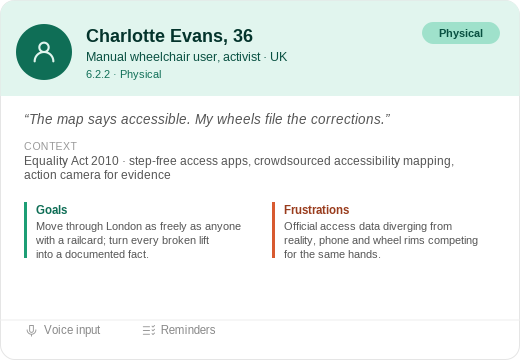
The map says accessible. My wheels file the corrections.
Goals
Move through London as freely as anyone with a railcard; turn every broken lift into a documented fact.
Frustrations
Official access data diverging from reality, phone and wheel rims competing for the same hands.
Profile
Charlotte Evans is a disability-rights activist with paralysis of the legs from polio. She uses a manual wheelchair and travels by public transport. Through digital platforms she advocates for disabled people's rights and works to improve the accessibility of her city.
Technology Environment
- On the move: laptop and power bank in a wheelchair bag
- Smartphone: transit apps, accessibility maps, live reporting
- Advocacy: social media, petition platforms, video meetings
- Recording: an action cam to document accessibility problems
Daily Scenario
At 8 a.m. Charlotte takes the underground to work. She opens an app to find the station's lift. But a lift the app shows as 'in service' is actually broken. She reports it to the app at once and shares the situation on social media.
# The accessibility-mapping system Charlotte uses
class AccessibilityMapper:
    def __init__(self):
        self.user_type = 'manual_wheelchair'
        self.report_priority = ['elevator', 'ramp', 'door_width', 'surface']

    def check_route(self, start, end):
        """Check a route's accessibility."""
        route_data = {'obstacles': [], 'facilities': []}
        for segment in route_segments:
            if segment.stairs and not segment.ramp:
                route_data['obstacles'].append({
                    'type': 'stairs_only', 'location': segment.location, 'severity': 'blocking'
                })
            if segment.slope > 8:  # steeper than 8%
                route_data['obstacles'].append({
                    'type': 'steep_slope', 'angle': segment.slope,
                    'length': segment.length, 'severity': 'difficult'
                })
        return route_data

    def crowd_report(self, issue):
        """Report an accessibility problem in real time."""
        report = {
            'timestamp': datetime.now(),
            'location': get_gps_location(),
            'issue_type': issue['type'],
            'impact_level': issue['severity'],
            'affected_users': ['wheelchair', 'mobility_aid']
        }
        broadcast_to_nearby_users(report)
        if issue['severity'] == 'critical':
            notify_authorities(report)
On the move, Charlotte checks live navigation on a phone mount attached to her wheelchair. It guides her only along wheelchair-accessible routes, steering around broken paving and steep grades.
At lunch she checks a new restaurant's accessibility. A crowdsourced accessibility-review app shows the entrance threshold height, under-table clearance, and toilet accessibility—photos and ratings from other wheelchair users are a big help.
In the afternoon she runs an online seminar on disability rights. The video platform provides a sign-language interpreter window and live captions together. Charlotte uses a mobile hotspot to broadcast reliably even while moving.
Challenges & Strategies
- Inaccurate information: official accessibility data often differs from reality. Charlotte uses user-report systems and verifies in person.
- Two-handed constraint: pushing the wheelchair while using a phone is hard. She relies on voice commands and bone-conduction earphones.
- Battery management: charging on the move is difficult. She always carries a high-capacity power bank and makes full use of low-power mode.
Design Implications
- Crowdsourced information: let users update accessibility data in real time.
- Offline support: basic accessibility information available without a network.
- Simple reporting: a UI that makes it easy to report problems while moving.
- Community connection: share information with disabled people in the same area.