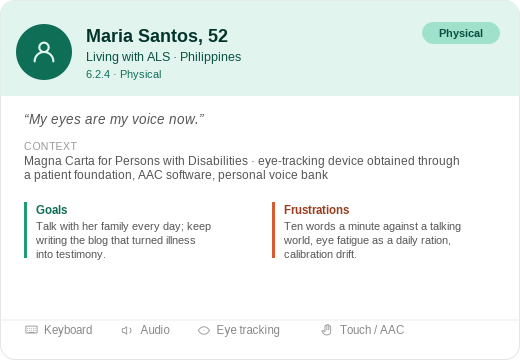
Maria Santos
Living with ALS
Philippines · Southeast Asia · Age 52
- Law
- Magna Carta for PWD (RA 7277)
- Services
- GCash / eGovPH
- Messaging
- Messenger
Assistive Technology
- Keyboard
- Audio
- Eye tracking
- Touch / AAC
My eyes are my voice now.
Goals
Talk with her family every day; keep writing the blog that turned illness into testimony.
Frustrations
Ten words a minute against a talking world, eye fatigue as a daily ration, calibration drift.
Profile
Maria Santos is four years past her ALS diagnosis and can now move only her eyes. She communicates with family using eye-tracking technology and shares her experience of living with the illness through a blog. Advanced assistive technology has given her back a voice.
Technology Environment
- Eye tracking: Tobii Dynavox PCEye, 98% accuracy
- Communication: Grid 3 AAC software, predictive text
- Voice output: a synthetic voice built from her own
- Environment control: smart-home devices controlled by gaze
Daily Scenario
At 9 a.m. Maria is seated in front of the eye-tracker with a caregiver's help. Calibration begins: gazing at nine points in turn lets the system track her eye movements precisely.
She wants to message her family. With her gaze she selects letters on a virtual keyboard one at a time. To enter a letter she fixes her gaze on the key for 1.5 seconds. Predictive text suggests a word and she selects it.
# Maria's eye-tracking communication system
class EyeTrackingAAC:
    def __init__(self):
        self.gaze_settings = {
            'dwell_time': 1.5,         # gaze time to select (s)
            'calibration_points': 9,
            'tolerance': 50,           # pixel error tolerance
            'blink_click': True        # blink to click
        }
        self.interface = {
            'layout': 'frequency_optimized',  # frequent letters centered
            'key_size': 'extra_large',        # 60x60 px
            'spacing': 20,
            'visual_feedback': 'zoom_on_gaze'
        }

    def quick_phrases(self):
        """Shortcuts for frequent phrases."""
        return {
            'basic_needs': [
                "I'm thirsty", "Please reposition me",
                "I'm in pain", "I need the bathroom"
            ],
            'emotional': [
                "I love you", "Thank you", "It's okay", "I'd like to rest a bit"
            ],
            'blog_templates': [
                "Today I'm feeling", "Hello everyone", "Thank you for your support"
            ]
        }
In the afternoon, Maria writes a blog post. Composing long text by gaze is tiring, but she wants to share her story with the world. She edits an old diary entry she once dictated and converted to text.
// Maria's blog post (written by eye tracking)
Title: A diary written with my eyes #87

Hello everyone.
Today marks two years since I started using the eye-tracker.

At first it took five minutes to write a single letter.
Now I can write a sentence in two minutes.
Slow, but I'm grateful to be able to express my thoughts.

The AI prediction really helps.
It remembers the phrases I use often and suggests them.
If I just write "Hello," it recommends "Hello everyone."

Technology has given me a voice again.
Slow as it is, I'm not giving up.

[Writing time: 47 min]
[Tools: Tobii PCEye + Grid 3]
In the evening, Maria video-calls her grandson and plays a pre-recorded voice message: "Hello Mateo, it's Grandma. Did you have fun at school today?" Live conversation is hard, but just seeing his face makes her happy.
Challenges & Strategies
- Extremely slow input: 10–15 words per minute is the limit. Maria makes maximum use of predictive text, abbreviations, and templates.
- Eye fatigue: long use leaves her eyes dry and tired. She strictly follows 50 minutes of use, 10 minutes of rest.
- Holding posture: eye tracking requires her head to stay still. She uses a comfortable head support and a posture cushion.
Design Implications
- Efficient layout: place frequent elements to minimize eye movement.
- Smart prediction: personalized AI-based text/command prediction.
- Fatigue management: usage tracking, break reminders.
- Backup options: an alternative when eye tracking fails (switch, caregiver call).