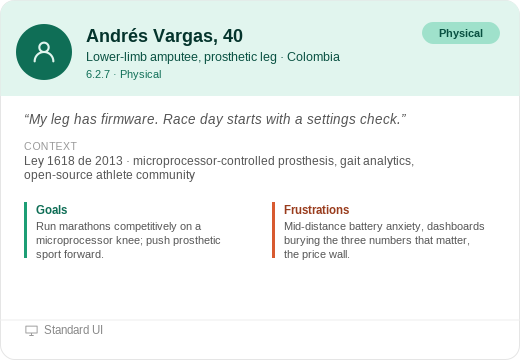
Andrés Vargas
Lower-limb amputee, prosthetic leg
Colombia · Latin America · Age 40
- Law
- Ley 1618 de 2013
- Services
- GOV.CO
- Messaging
Assistive Technology
- Standard UI
My leg has firmware. Race day starts with a settings check.
Goals
Run marathons competitively on a microprocessor knee; push prosthetic sport forward.
Frustrations
Mid-distance battery anxiety, dashboards burying the three numbers that matter, the price wall.
Profile
Andrés Vargas is a marathon runner who uses an advanced prosthetic leg after losing his left leg in a traffic accident. He uses a smart prosthesis and various fitness apps to improve his athletic performance, and also serves as a technical advisor for the development of disability sport.
Technology Environment
- Smart prosthesis: microprocessor-controlled, Bluetooth connectivity
- Monitoring: gait-analysis app, pressure-distribution measurement
- Training: pro fitness tracker, rehabilitation app
- Data analysis: cloud-based performance tracking
Daily Scenario
At 6 a.m. Andrés puts on the prosthesis and starts adjustments, opening a phone app to check its settings. Today's session is hill training, so he switches to 'incline mode'; the prosthesis's hydraulic damper and angle adjust automatically.
// Andrés's smart-prosthesis control system
const smartProstheticControl = {
  activityModes: {
    walking: { resistance: 'medium', angleRange: 20, cadence: 'adaptive' },
    running: { resistance: 'low', angleRange: 45, energyReturn: 'high', shockAbsorption: 'maximum' },
    stairs:  { resistance: 'high', angleAdjust: 'automatic', stability: 'enhanced' },
    cycling: { resistance: 'minimal', angleRange: 90, powerAssist: 'off' }
  },
  monitoring: {
    sensors: { pressure: 'heel_toe_distribution', angle: 'knee_ankle_coordination', temperature: 'socket_temperature', battery: 'remaining_hours' },
    alerts: { highPressure: 'vibration_alert', lowBattery: 'audio_notification', maintenanceNeeded: 'app_reminder' }
  },
  analytics: {
    daily: { steps: 'count_and_quality', distance: 'gps_tracked', calories: 'effort_based', symmetry: 'gait_balance_score' },
    longTerm: { wear_patterns: 'component_lifetime', performance_trends: 'speed_endurance', rehabilitation_progress: 'therapist_reports' }
  }
};
As he starts running, Andrés syncs his fitness watch with the prosthesis app, monitoring pressure distribution, stride symmetry, and ground-contact time across both legs in real time. Seeing the prosthetic side tire slightly faster, he adjusts his pace.
# Andrés's running-data analysis
class ProstheticRunningAnalysis:
    def __init__(self):
        self.baseline = {
            'intact_limb': {'contact_time': 250, 'force': 2.5},
            'prosthetic_limb': {'contact_time': 265, 'force': 2.3}
        }

    def realtime_feedback(self, current_data):
        """Generate real-time feedback."""
        symmetry = self.calculate_symmetry(current_data)
        feedback = {}
        if symmetry < 0.85:
            feedback = {
                'alert': 'asymmetry_detected',
                'suggestion': 'focus_on_prosthetic_push_off',
                'vibration': 'prosthetic_side'
            }
        if self.detect_fatigue_pattern(current_data) > 0.7:
            feedback['pace_adjustment'] = 'reduce_by_10%'
        return feedback
In the afternoon, Andrés mentors new prosthesis users at a rehabilitation center, showing his own gait data on a tablet: "At first my asymmetry was severe, but I improved it by monitoring steadily with this app."
In the evening he cleans and charges the prosthesis and checks the day's summary in the app: 15km total, average symmetry 92%, prosthesis battery at 40%, with a reminder that the next scheduled maintenance is 200km away.
Challenges & Strategies
- Technology dependence: when the battery dies, the prosthesis's functions are limited. Andrés always carries a spare battery and has learned the manual mode.
- Data overload: too much information can itself be stressful. He checks only 3–4 key metrics in real time and reviews the rest after training.
- Cost burden: smart prostheses and their apps are expensive. He looks for open-source alternatives and shares data with a community to improve them together.
Design Implications
- Real-time feedback: concise information that's easy to check mid-exercise.
- Long-term tracking: manage rehabilitation progress and prosthesis wear together.
- Community features: share experience and tips with similar users.
- Clinical integration: share data easily with doctors and physical therapists.