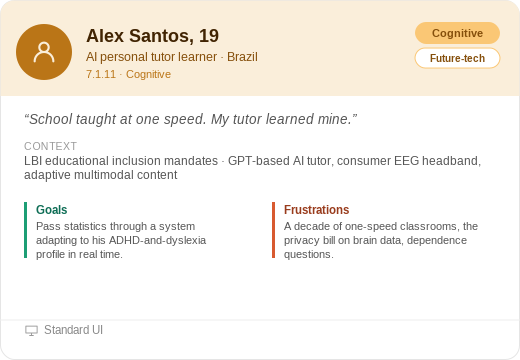
Alex Santos
AI personal tutor learner
Brazil · Latin America · Age 19
- Law
- LBI (Lei 13.146/2015)
- Services
- gov.br
- Messaging
Assistive Technology
- Standard UI
School taught at one speed. My tutor learned mine.
Goals
Pass statistics through a system adapting to his ADHD-and-dyslexia profile in real time.
Frustrations
A decade of one-speed classrooms, the privacy bill on brain data, dependence questions.
Profile
Alex Santos is a university first-year with ADHD and dyslexic traits, and a beta tester for the latest AI-based personalized-learning system. The AI tutor, 'Socrates,' analyzes Alex's learning patterns, strengths, and weaknesses in real time to provide an optimized learning path. Traditional schooling was hard, but with the AI tutor Alex shows remarkable achievement.
Technology Environment
- AI tutor: GPT-based conversational learning assistant
- Brainwave monitoring: real-time measurement of focus and comprehension
- Adaptive content: difficulty and format adjusted in real time
- Multimodal learning: visual, auditory, kinesthetic integrated
Daily Scenario
Tuesday afternoon, Alex starts studying statistics, putting on a light EEG headband and activating the AI tutor. "Hi, Alex! How are you feeling today? Your brainwave pattern looks a bit tired—shall we start with a short session?"
# Alex's AI tutor system
class PersonalizedAITutor:
    def adaptive_content_delivery(self):
        """Adjust content in real time."""
        if self.current_state['attention_level'] < 0.6:
            return {'format': 'interactive_game', 'duration': '5_minutes', 'content_type': 'visual_puzzles'}
        elif self.user.has_difficulty_with('reading'):
            return {'format': 'animated_explanation', 'narration': True,
                    'text_overlay': 'dyslexia_friendly_font', 'pacing': 'user_controlled'}

    def real_time_comprehension_check(self):
        """Check comprehension live."""
        signals = self.read_eeg_data()
        if signals['confusion_index'] > 0.7:
            self.pause_and_explain_differently()

    def emotional_support_layer(self):
        """Emotional support and motivation."""
        if self.detect_frustration():
            return self.choose([
                "Want to take a quick break? You're doing great!",
                "It's natural for this part to be hard. Let me explain it another way.",
                "You understand 23% more than five minutes ago! Great progress!"
            ])
When Alex says, "I don't get what standard deviation is," the AI immediately explains using Alex's interests: "Let me use your favorite game, LoL. Think of your teammates' CS (creep score)…"
Game characters appear on screen, each one's CS shown as a bar graph. When the AI visualizes how far each is from the average, Alex gets it: "Oh, this shows how big the skill gap is!"
Thirty minutes in, the AI suggests, "Your focus is dropping. Want to stretch for five minutes? Or play a short game reviewing standard deviation?" Alex picks the game—a minigame collecting Pokémon and computing the standard deviation of each one's stats.
Future Impact
- Real-time neural feedback: EEG data reveals comprehension and focus live, so content adjusts instantly to match.
- Personal knowledge graph: the AI maps exactly what Alex knows and doesn't, connecting new concepts to existing knowledge.
- Emotional attunement: it recognizes the learner's emotional state and offers encouragement to sustain motivation.
Design Implications
- Hyper-personalization: a tailored experience combining brainwaves, learning history, and preferences.
- Instant adaptation: detect and respond to the learner's state in milliseconds.
- Emotional intelligence: emotional support and motivation beyond mere knowledge delivery.
- Ethical considerations: protect the privacy of brain data and the learner's autonomy.