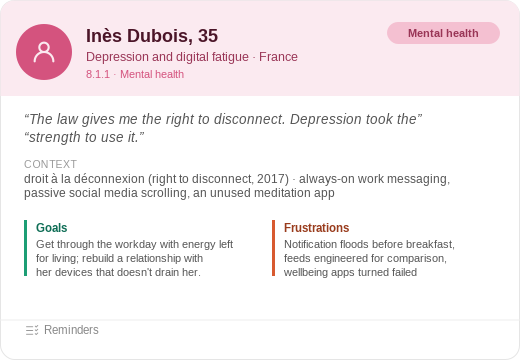
Inès Dubois
Depression and digital fatigue
France · Europe · Age 35
- Law
- RGAA · EAA
- Services
- FranceConnect
- Messaging
Assistive Technology
- Reminders
The law gives me the right to disconnect. Depression took the strength to use it.
Goals
Get through the workday with energy left for living; rebuild a relationship with her devices that doesn't drain her.
Frustrations
Notification floods before breakfast, feeds engineered for comparison, wellbeing apps turned failed obligations.
Profile
Inès Dubois is a marketing manager at a large company who has lived with major depressive disorder for two years. Since remote work became routine after the pandemic, the boundary between work and life has blurred, and she feels worn down by constant digital connectivity. She experiences low motivation, reduced concentration, and disrupted sleep, caught in a cycle where device use worsens her symptoms.
Technology Environment
- Work tools: Slack, Teams, email (always-on notifications)
- Personal device: smartphone (≈8 hours/day)
- Wellbeing apps: a meditation app (installed, rarely opened)
- Social: Instagram, Facebook (passive scrolling)
Daily Scenario
9 a.m. Monday. The moment Inès wakes she checks her phone—87 work messages piled up over the weekend, plus dozens of social notifications, all at once. Overwhelmed, she wants to crawl back under the covers, but a 10 a.m. video call forces her up.
She opens her laptop and Slack pings without pause. Watching colleagues' lively threads, she feels she's the only one falling behind. She should reply but can't think what to say, so she leaves a simple "Got it" and closes the window.
// Inès's digital-wellbeing settings — attempted
const digitalWellbeingAttempts = {
  notifications: {
    workHours: '09:00-18:00',   // set, but not kept
    weekendMode: false,         // disabled
    doNotDisturb: '22:00-07:00' // often ignored
  },
  appLimits: {
    instagram: '30 min',        // exceeded daily
    facebook: '30 min',         // exceeded daily
    workApps: 'no limit'        // boundaryless work
  },
  mentalHealthTools: {
    meditationApp: 'installed, last used: 3 months ago',
    moodTracker: 'installed, unused',
    therapyApp: 'considering'
  }
};
At lunch, Inès scrolls Instagram aimlessly. Her friends' happy-looking photos make her own life feel small; a peer's promotion announcement drops her into a deep sense of helplessness. She feels she should comment, but lacks the energy even to write congratulations.
By 3 p.m. her concentration is gone. A single short email takes 30 minutes—writing and deleting, over and over—until she just sends "I'll reply tomorrow."
At 7 p.m. the workday is officially over, but she can't close the laptop, anxious she'll miss something important, while at the same time not wanting to look at a screen at all—a contradiction she's stuck in.
Challenges & Strategies
The main challenges Inès faces:
- Loss of motivation: she's lost all interest in digital activities she once enjoyed (blogging, photo editing). She tries to start with small goals, but even those feel heavy.
- Negative effects of social media: comparison with others badly erodes her self-esteem. She considers deleting social apps but fears total isolation.
- Failure to set digital boundaries: with no separation between work and personal life, she's stressed around the clock. A "digital sabbath" attempt fails because of the anxiety.
- Sleep disruption: phone use before bed degrades sleep quality. Blue-light glasses helped only marginally.
Design Implications
- Gradual engagement: interfaces that let users participate at their own pace, without pressure.
- Positive reinforcement: micro-interactions that recognize and celebrate even small wins.
- Less comparison: design that focuses on personal progress rather than comparison with others.
- Flexible boundaries: notification and access controls users can easily turn on and off.