Zhang Yu
Office worker with panic disorder
China · East Asia · Age 38
- Law
- Barrier-Free Environment Law 2023
- Services
- WeChat super-app
- Messaging
Assistive Technology
- Magnification
- Reminders
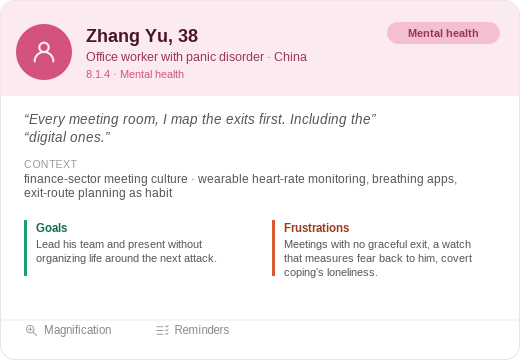
Every meeting room, I map the exits first. Including the digital ones.
Goals
Lead his team and present without organizing life around the next attack.
Frustrations
Meetings with no graceful exit, a watch that measures fear back to him, covert coping's loneliness.
Profile
Zhang Yu is a middle manager at a finance company who was diagnosed with panic disorder after his first panic attack two years ago. Fear of unpredictable attacks has greatly restricted his daily life. He especially fears situations he can't easily escape, like video meetings or presentations. He obsessively checks his heart rate on a smartwatch and uses various meditation and breathing apps.
Technology Environment
- Wearable: Apple Watch (heart-rate monitoring)
- Health apps: breathing app, meditation app, panic-attack response app
- Work: always locates the 'leave' button in video meetings
- Emergency contacts: speed-dial set for family, doctor
Daily Scenario
Thursday at 9:30 a.m., Zhang Yu's anxiety rises ahead of an all-hands meeting. His smartwatch shows his heart rate up to 95. "What if I have another attack?"—and the thought pushes his heart rate higher.
Before entering the meeting room, he runs a breathing app in the restroom. Following "Breathe in for 4, hold for 7, out for 8," he regulates his breathing. He feels a bit calmer, but seeing the closed meeting-room door tenses him again.
// Zhang Yu's panic-attack response system
const panicManagementSystem = {
  earlyWarning: {
    heartRate: 'alert above 85',
    symptoms: ['shortness of breath', 'trembling hands', 'dizziness', 'derealization'],
    triggerTracking: true
  },
  copingTools: {
    immediate: { breathingApp: '4-7-8 breathing', groundingTechnique: '5-4-3-2-1 senses', escapeRoute: 'always locate the exit' },
    preventive: { meditation: '10 min daily', exercise: 'improve HRV', medication: 'carry rescue meds' }
  },
  digitalSafety: {
    meetingSetup: { camera: 'can turn off if needed', virtualBackground: 'reduce distraction', chatBackup: 'alternative when speaking is hard' }
  }
};
The video meeting begins and his turn approaches. Suddenly his throat tightens and his breathing quickens. He sees his own anxious face on camera. "Stay calm," he tells himself, but a fear of losing control sweeps over him.
Zhang Yu says, "My connection isn't great for a moment," and turns off his video. Following the watch's breathing app, he breathes deeply and takes half a rescue tablet he'd kept under the desk. After five minutes he's calmed enough to rejoin the meeting.
After the meeting, he logs the episode in a panic-attack tracking app, recording the triggers (closed space, many people), symptom intensity (7 of 10), and the coping method and its effect in detail. He'll share this data at next week's psychiatry appointment.
Challenges & Strategies
- Anticipatory anxiety: worrying in advance about an attack actually triggers symptoms. Zhang Yu tries mindfulness meditation to focus on the present.
- Avoidance: he avoids situations where an attack might occur (elevators, subway, video meetings). He uses a graded-exposure app to challenge himself slowly.
- Over-monitoring bodily sensations: continually checking heart rate and breathing amplifies anxiety. He limits smartwatch alerts to three times a day.
- Isolation: he hides his condition from colleagues and tries to cope alone. He finds comfort in an online panic-disorder support group.
Design Implications
- Quick-exit options: a clear path to leave any situation at any time.
- Graded-exposure tools: features to overcome anxiety step by step.
- Real-time support: response tools immediately accessible in a crisis.
- Privacy protection: options to cope without being exposed to others.