최강윤 · Choi Kang-yun
Artist with bipolar disorder
Korea · East Asia (Korea) · Age 40
- Law
- 장차법 · KWCAG 2.2
- Services
- 정부24 / 카카오·토스
- Messaging
- KakaoTalk
Assistive Technology
- Magnification
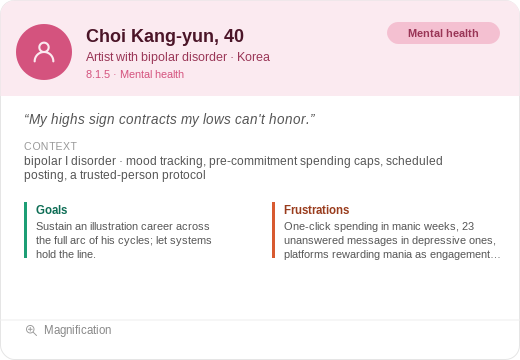
My highs sign contracts my lows can't honor.
Goals
Sustain an illustration career across the full arc of his cycles; let systems hold the line.
Frustrations
One-click spending in manic weeks, 23 unanswered messages in depressive ones, platforms rewarding mania as engagement.
Profile
Choi Gang-yoon is a freelance illustrator living with bipolar I disorder. During manic phases, overflowing creativity and energy drive all-night work and impulsive new projects; during depressive phases, all creative activity stops and even getting out of bed is hard. Mood shifts are directly reflected in his digital activity patterns, showing extreme behavior especially on social media and in online shopping.
Technology Environment
- Creative tools: Procreate, Photoshop (extreme usage patterns)
- Mood tracking: a bipolar-specific mood tracker
- Finance: a banking app with spending limits
- Social media: activity patterns swing sharply with mood
Daily Scenario
[Manic episode — two weeks ago] At 3 a.m., Gang-yoon hasn't slept for 48 hours and is working on a new art series. To express the flood of ideas in his head, he runs five projects at once. He posts his process every 10 minutes on social media and starts a live stream on a whim.
"Everyone! I'm launching a new art movement—breaking down the boundary between digital and analog…" On an online art-supply site he impulsively orders ₩2,000,000 worth of materials. When he exceeds one card's limit, he tries paying with another.
At the same time he pitches several clients "innovative project proposals" of unrealistic scale. The messages are long and scattered, full of grandiose confidence.
[Depressive episode — now] At 2 p.m., Gang-yoon hasn't left his bed in three days. Deadlines loom for the projects he impulsively started two weeks ago, but he lacks even the energy to turn on his tablet. Twenty-three unread client messages have piled up.
# Gang-yoon's digital patterns by mood state
class BipolarDigitalPattern:
    def __init__(self):
        self.mood_state = 'depression'   # current state

    def manic_episode(self):
        return {
            'screen_time': '18-20 hours/day',
            'sleep': '0-2 hours',
            'social_media': {'posts': '50+/day', 'messages': 'excessive length, scattered', 'live_streams': 'impulsive, unplanned'},
            'spending': {'amount': 'out of control', 'items': 'unnecessary bulk purchases', 'regret': 'severe during depression'},
            'projects': {'started': '10+ at once', 'completed': 'almost none', 'quality': 'inconsistent'}
        }

    def depressive_episode(self):
        return {
            'screen_time': 'avoidance or mindless scrolling',
            'sleep': '15+ hours',
            'social_media': {'posts': 'none', 'messages': 'unread', 'account': 'considering deactivation'},
            'work': {'productivity': 'fully stopped', 'communication': 'avoided', 'income': 'none'},
            'self_care': {'medication': 'forgotten', 'therapy_apps': 'unused', 'mood_tracking': 'logging stopped'}
        }
Opening his banking app, he finds bills piled up from manic-phase impulse buys. Looking at expensive equipment he'll never use, he sinks into self-blame. He opens social media, sees the grandiose posts he made two weeks ago, and deactivates the account in shame.
The mood tracker reminds him to take his medication, but he ignores it. His doctor suggested a video consultation, but unable to face the camera, he keeps postponing it.
Challenges & Strategies
- Extreme behavior patterns: excessive digital activity in mania and total disconnection in depression alternate. Gang-yoon considers entrusting a trusted friend with temporary management of his social accounts.
- Impulse-control failure: manic-phase online shopping and indiscriminate project-taking become a heavy burden in depression. He asks his card company to set a daily limit.
- Inconsistent treatment engagement: his use of digital therapy tools is irregular depending on mood. He looks for an app his family can help monitor.
- Damage to reputation: inappropriate manic-phase online behavior harms his professional credibility. He uses scheduled posting to curb impulsive posts.
Design Implications
- Behavior-limit options: safeguards the user can't easily undo on their own once set in advance.
- Mood-linked features: adaptive design where the interface and functions adjust to mood state.
- Caregiver linkage: sharing features to co-manage with a trusted person.
- Undo features: a grace period to cancel impulsive actions.