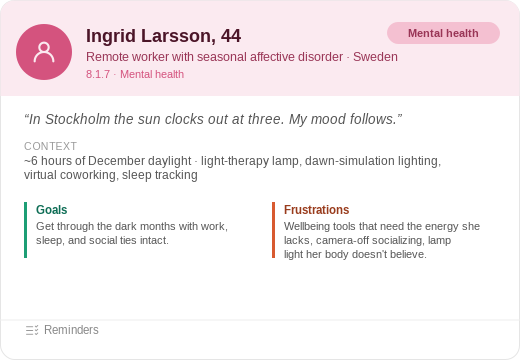
Ingrid Larsson
Remote worker with seasonal affective disorder
Sweden · Europe · Age 44
- Law
- DOS Act · EAA
- Services
- BankID / 1177.se
- Messaging
- WhatsApp · Messenger
Assistive Technology
- Reminders
In Stockholm the sun clocks out at three. My mood follows.
Goals
Get through the dark months with work, sleep, and social ties intact.
Frustrations
Wellbeing tools that need the energy she lacks, camera-off socializing, lamp light her body doesn't believe.
Profile
Ingrid Larsson is a content marketer who experiences seasonal affective disorder (SAD) from October to March each year. As daylight wanes, she has low energy, oversleeps, craves carbohydrates, and withdraws socially. After switching to fully remote work her symptoms worsened, and she is seeking ways to cope using digital tools.
Technology Environment
- Lighting: smart lights linked to a light-therapy app
- Social: online communities, virtual coworking spaces
- Health: sleep tracking, vitamin-D reminders, exercise apps
- Work: flexible work-hours management tools
Daily Scenario
A December Wednesday at 7 a.m., Ingrid struggles to rise even when the alarm sounds. It's still dark outside and she doesn't want to leave the duvet. A smart light gradually brightens to simulate sunrise, but her body knows it isn't real daylight.
Only at 9 does she manage to get up and sit at the laptop. She switches on a 10,000-lux light-therapy lamp and starts work bathed in its bright light, but her focus is poor and everything feels meaningless.
# Ingrid's SAD-management digital routine
class SADManagementRoutine:
    def __init__(self):
        self.season = 'winter'
        self.mood_baseline = 3   # out of 10

    def morning_routine(self):
        return {
            '07:00': 'smart light auto-on (2000K -> 5000K)',
            '07:30': 'check sleep stats - 9 hours slept',
            '08:00': 'start light therapy (30 min)',
            '08:30': 'vitamin-D reminder',
            '09:00': 'join virtual coworking space'
        }

    def light_exposure_tracking(self):
        return {
            'natural_light': '30 min (overcast)',
            'light_therapy': '45 min',
            'screen_time': '8 hours (blue light)',
            'outdoor_time': '0 min 😔'
        }
At lunch, Ingrid joins an online 'lunch buddy' program, eating with a colleague—if only on screen—and briefly forgetting her loneliness. But when the call ends, the isolation rushes back.
At 3 p.m. the winter sun is already sinking. Ingrid feels her energy crash. She tries to push through with coffee and chocolate but worries it'll spiral into a carb binge.
An exercise app pings, "Shall we get moving today?", but it's cold and dark outside and she has no motivation to exercise indoors. She searches "winter-depression yoga" on YouTube but lacks even the energy to start a video.
At 7 p.m., Ingrid joins an online SAD support group, finding comfort in sharing experiences with people who have similar symptoms. She downloads a 'virtual beach walk' VR app someone recommended, but lacks the energy to put on the headset and puts it off.
Challenges & Strategies
- Lack of light: natural-light exposure is extremely limited. Ingrid set reminders to force a short lunchtime walk, but gives up when the weather is bad.
- Social isolation: remote-work isolation worsens her SAD. She tries to join online gatherings regularly but often sits with camera off and muted when low.
- Disrupted rhythm: her sleep-wake cycle breaks and day and night flip. She uses smart lights and a sleep tracker, but with nothing to enforce them, easily ignores them.
- Lack of exercise: cold, dark weather collapses her physical activity. She subscribes to several indoor-exercise apps but mostly doesn't use them.
Design Implications
- Season-aware features: tailored support based on the user's location and season.
- Light-exposure tracking: monitor and recommend natural and artificial light.
- Foster social connection: low-pressure online interaction.
- Stronger motivation: positive reinforcement that recognizes even small wins.