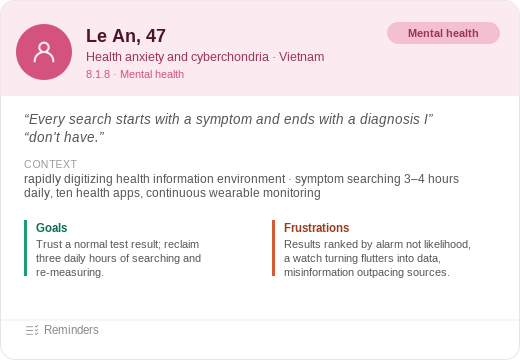
Le An
Health anxiety and cyberchondria
Vietnam · Southeast Asia · Age 47
- Law
- Law on PWD 2010
- Services
- VNeID / Zalo ecosystem
- Messaging
- Zalo
Assistive Technology
- Reminders
Every search starts with a symptom and ends with a diagnosis I don't have.
Goals
Trust a normal test result; reclaim three daily hours of searching and re-measuring.
Frustrations
Results ranked by alarm not likelihood, a watch turning flutters into data, misinformation outpacing sources.
Profile
Le An is a middle-school vice-principal living with health anxiety and cyberchondria. He interprets minor bodily symptoms as signs of serious illness and amplifies his anxiety by searching symptoms online. Exposure to unreliable medical information and extreme cases has worsened his health anxiety further.
Technology Environment
- Search pattern: 3–4 hours of symptom searching a day
- Health apps: 10+ installed (heart rate, blood pressure, symptom checkers)
- Wearable: continuous health monitoring via smartwatch
- Online forums: active in several health communities
Daily Scenario
Tuesday at 6 a.m., Le An wakes from a heart palpitation he felt overnight. He immediately picks up his phone and searches "causes of heart palpitations." When words like 'heart attack,' 'arrhythmia,' and 'heart failure' appear in the results, fear sweeps over him.
He checks his heart rate on his smartwatch: 85 bpm. He searches again, "is resting heart rate 85 dangerous." One site says it's normal, another recommends seeing a doctor. His anxiety rises and his heart rate climbs to 95.
// Le An's cyberchondria pattern
const cyberchondriaPattern = {
  triggerSymptom: 'heart palpitation',
  searchProgression: [
    'causes of heart palpitations',
    'danger of heart palpitations',
    'early signs of arrhythmia',
    'heart attack at a young age',
    'sudden death causes in your 40s',
    'types of heart tests',
    'symptoms that need the ER'
  ],
  timeSpent: '3 hours 27 min',
  sitesVisited: 47,
  anxietyLevel: '1 -> 8 (out of 10)',
  digitalBehavior: {
    screenshotSymptoms: true,
    bookmarkPages: 23,
    joinForums: ['heart-disease forum', 'health-anxiety group'],
    orderTests: ['ECG device', 'blood-pressure monitor upgrade']
  },
  reassuranceSeeking: { familyMessages: 5, doctorCalls: 2, emergencyRoomVisits: '3rd time considering this month' }
};
During morning classes, Le An keeps checking his pulse while teaching, glancing at his smartwatch's heart-rate alerts every five minutes. Thinking he sees an odd pattern, he goes to the restroom to take an ECG with a medical app.
At lunch, when a colleague says he "looks pale," Le An's anxiety peaks. He searches "why a pale complexion" and "pale face heart disease," skipping lunch.
In the afternoon he posts his symptoms in detail to an online health forum: "Late-40s man, heart palpitations since dawn today…" He keeps refreshing for replies. When someone says "see a doctor," he grows more anxious; when someone says "you'll be fine," he doubts them.
At home the symptom searching continues. His wife says "stop searching," but he replies, "It's my body, I have to look after it," and downloads a new symptom-checker app. Until he sleeps he watches videos like "heart-disease self-diagnosis" and "when to go to the ER."
Challenges & Strategies
- Search addiction: he can't stop searching symptoms, and the more he searches the more anxious he becomes. Le An installed a search-time-limit app but keeps disabling it.
- Confirmation bias: he selectively remembers only worst-case scenarios. He tries to find balanced information but attends only to the negative.
- Over-monitoring bodily sensations: he reads even normal bodily responses as warning signs. He tried turning off his wearable but, too anxious, turned it back on.
- Distrust of clinicians: even when a doctor says "nothing's wrong," he can't believe it and seeks second and third opinions. He tends to trust online information more.
Design Implications
- Trustworthy sources: curation providing only verified medical information.
- Search limits: time limits and warnings on health-related searches.
- Balanced information: show common causes before extreme cases.
- Expert connection: quick consultation with verified clinicians.