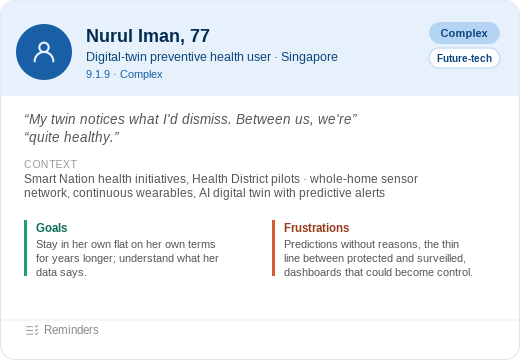
Nurul Iman
Digital-twin preventive health user
Singapore · East Asia · Age 77
- Law
- Enabling Masterplan · IMDA guidelines
- Services
- Singpass
- Messaging
Assistive Technology
- Reminders
My twin notices what I'd dismiss. Between us, we're quite healthy.
Goals
Stay in her own flat on her own terms for years longer; understand what her data says.
Frustrations
Predictions without reasons, the thin line between protected and surveilled, dashboards that could become control.
Profile
Nurul Iman is an older adult living with mild cognitive impairment and hypertension, and a beneficiary of cutting-edge digital-twin technology. A 'digital twin' built from data gathered by sensors throughout her home and wearable devices monitors and predicts her health in real time. Drawing on her experience as a retired nurse, she embraces the new technology positively.
Technology Environment
- Sensor network: activity, sleep, fall detection, environmental sensors
- Wearables: continuous blood-pressure monitor, ECG, glucose monitor
- AI analysis: pattern recognition, early anomaly detection
- Digital twin: health visualized as a 3D avatar
Daily Scenario
At 6 a.m., as Nurul wakes, bedroom sensors analyze her sleep quality. The digital-twin system tells her in a gentle voice, "Tossing during sleep was up 23% from yesterday. Your blood pressure is also higher than usual."
On the way to the bathroom, floor pressure sensors analyze her gait—her stride is shorter and more irregular than usual. The AI computes a fall-risk score and automatically brightens the living-room lights.
# Nurul's digital-twin health-prediction system
class DigitalTwinHealthcare:
    def __init__(self, user_profile):
        self.baseline = self.establish_baseline(user_profile)
        self.sensors = {
            'movement': ['gait_analysis', 'fall_risk', 'activity_level'],
            'vital_signs': ['bp', 'heart_rate', 'respiration', 'temperature'],
            'cognitive': ['speech_patterns', 'daily_routine_adherence', 'response_time'],
            'environmental': ['room_usage', 'sleep_quality', 'medication_compliance']
        }

    def predictive_analytics(self, real_time_data):
        # Example: early warning of cognitive decline
        if self.detect_cognitive_pattern_change():
            self.notify_care_team({
                'type': 'cognitive_decline_risk',
                'confidence': 0.78,
                'timeframe': '2-3 weeks',
                'recommendation': 'Schedule cognitive assessment',
                'early_interventions': ['Increase social interactions', 'Start brain training exercises', 'Review medication side effects']
            })
        return {'immediate_risks': self.assess_immediate_risks(real_time_data), 'trend_analysis': self.analyze_trends_30_days()}

    def generate_avatar_visualization(self):
        # Show health status by color on a 3D avatar
        return {'cardiovascular': 'yellow', 'musculoskeletal': 'green', 'cognitive': 'orange', 'overall_score': 72}
After lunch, Nurul's digital twin detects an unusual pattern: "Over the last three days, your activity between 2 and 4 p.m. has been about 40% of usual. Low mood or fatigue may have increased. A light walk is recommended." Following the AI's suggestion, Nurul takes a turn around the apartment garden.
In the evening, her physician reviews the digital-twin report remotely: "This patient is predicted to have a 35% increased fall risk within two weeks. Please consider adjusting the dose of the blood-pressure medication that can cause dizziness." The doctor adjusts the medication via a video consultation.
Future Impact
- Predictive intervention: prevent problems before they occur. Nurul can now head off falls and acute illness in advance.
- Personalized care: she receives management tailored to her own health patterns, not generic guidelines—cared for as 'Nurul,' not as a 'typical older person.'
- Balance of autonomy and safety: monitored 24/7, she feels protected rather than surveilled, and can live independently for longer.
Design Implications
- Transparent AI: explain the basis for predictions in an easy-to-understand way.
- Privacy protection: minimize data collection and clearly explain its purpose.
- Human-centered interface: visualize complex data intuitively.
- Gradual trust-building: improve technology acceptance through small successes.
- Family involvement: a structure where caregivers and clinicians can intervene appropriately.