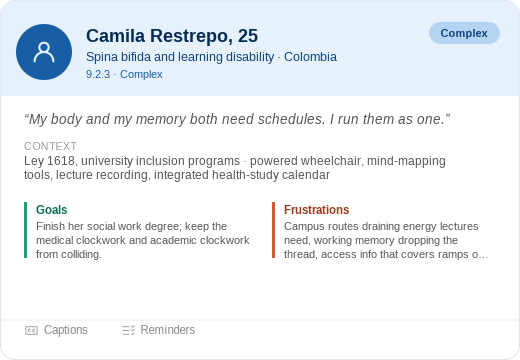
Camila Restrepo
Spina bifida and learning disability
Colombia · Latin America · Age 25
- Law
- Ley 1618 de 2013
- Services
- GOV.CO
- Messaging
Assistive Technology
- Captions
- Reminders
My body and my memory both need schedules. I run them as one.
Goals
Finish her social work degree; keep the medical clockwork and academic clockwork from colliding.
Frustrations
Campus routes draining energy lectures need, working memory dropping the thread, access info that covers ramps or reading but never both.
Profile
Camila Restrepo has congenital spina bifida with lower-limb paralysis, plus a learning disability from hydrocephalus sequelae. She majors in social work at university, uses a wheelchair, and needs catheter management. Her information-processing speed is slow and working memory limited, but she continues her studies using visual-organization tools.
Technology Environment
- Mobility: powered wheelchair, campus navigation app
- Learning aids: mind-mapping software, voice-recording app
- Health management: catheterization-schedule reminders, pressure-sore-prevention timer
- Note-taking: digital pen, OCR conversion software
Daily Scenario
At 10 a.m. in the lecture hall, Camila sits in a wheelchair-accessible spot and opens her laptop. She records the lecture while organizing only key keywords into a mind map. Complex theory is hard to grasp all at once, so structuring it visually helps.
// Camila's integrated learning-support system
const learningAccessibilitySystem = {
  noteOrganization: {
    structure: 'mindmap',
    colorCoding: { mainConcept: '#FF6B6B', subConcept: '#4ECDC4', example: '#95E1D3', important: '#F7DC6F' },
    autoSave: 'every_30_seconds', cloudSync: true
  },
  cognitiveSupport: {
    lectureRecording: { autoTranscribe: true, keywordHighlight: true, playbackSpeed: [0.5, 0.75, 1.0], bookmarks: 'unlimited' },
    breakReminders: { study: 'every_25_minutes', stretch: 'every_hour', catheter: 'every_4_hours', positionChange: 'every_2_hours' }
  },
  physicalAccess: {
    voiceCommands: { 'next slide': 'arrow_right', 'previous': 'arrow_left', 'bookmark here': 'ctrl+b', 'break time': 'pause_all' },
    gestureControl: 'head_tracking', emergency: 'one_button_alert'
  }
};
At lunch, Camila looks for an accessible toilet to change her catheter, searching the campus app for the nearest one. But the app lacks crucial information—whether there's a bed or fold-down table inside—which makes her anxious.
In an afternoon study group, Camila works on a project with other students. Finding it hard to process lots of information at once, she suggests a collaboration tool that visualizes the discussion in real time. With every idea organized on screen, following along is far easier.
In the evening, doing homework, she hears the position-change alarm that sounds every two hours—essential for pressure-sore prevention. But when it rings mid-focus, her train of thought breaks. Camila wants a smarter alert system that considers her workflow.
Challenges & Strategies
- Overlap of physical limits and cognitive load: the fatigue of wheelchair travel further lowers her focus. Camila makes active use of online lectures to conserve energy.
- Complexity of time management: she must account for study time, travel time, and health-care time. She manages every schedule with an integrated calendar app.
- Lack of accessibility information: physical-access and learning-access information are separate. Camila wants to build an app to share firsthand information with other students.
Design Implications
- Integrated health-learning management: smart coordination of physical care and academic schedule.
- Reduce cognitive load: visualize and simplify information.
- Flexible alerts: adaptive alerts that don't disrupt workflow.
- Comprehensive accessibility information: integrate physical, sensory, and cognitive access.