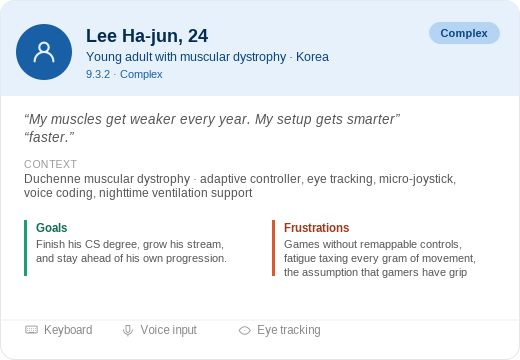
이하준 · Lee Ha-jun
Young adult with muscular dystrophy
Korea · East Asia (Korea) · Age 24
- Law
- 장차법 · KWCAG 2.2
- Services
- 정부24 / 카카오·토스
- Messaging
- KakaoTalk
Assistive Technology
- Keyboard
- Voice input
- Eye tracking
My muscles get weaker every year. My setup gets smarter faster.
Goals
Finish his CS degree, grow his stream, and stay ahead of his own progression.
Frustrations
Games without remappable controls, fatigue taxing every gram of movement, the assumption that gamers have grip strength.
Profile
Lee Ha-jun is a university student with Duchenne muscular dystrophy. He uses a powered wheelchair, and with much-weakened arm strength he enjoys gaming with a special controller. His respiratory muscles have also weakened, so he uses a ventilator at night. He majors in computer science and is also a game streamer, passionate about transcending physical limits through technology.
Technology Environment
- Gaming: adaptive Xbox controller, eye-tracking system
- Computer control: micro-joystick, voice commands
- Daily support: advanced powered-wheelchair control, smart home
- Health management: respiratory monitoring, muscle-strength tracking app
Daily Scenario
At 10 a.m. in an online lecture, Ha-jun sits at his laptop. Resting his arm on a wrist rest, he operates a special mouse with only small fingertip movements. For typing he uses an on-screen keyboard and predictive text. Writing a sentence takes time, but when coding, autocomplete speeds him up.
# Ha-jun's progressive-weakness response system
class ProgressiveMuscleWeakness:
    def __init__(self):
        self.current_abilities = {
            'finger_movement': 0.3,    # 30% strength
            'wrist_movement': 0.1,
            'shoulder_movement': 0.05,
            'breathing_capacity': 0.6
        }
        self.adaptive_controls = {
            'gaming': {'primary': 'eye_tracking', 'secondary': 'micro_joystick', 'sensitivity': self.calculate_optimal_sensitivity(), 'custom_macros': self.frequently_used_combos()},
            'coding': {'input': 'voice_coding', 'ide_integration': 'ai_pair_programmer', 'snippet_expansion': 'aggressive', 'eye_strain_prevention': 'blink_reminders'}
        }

    def progression_planning(self):
        # Staged transition plan for future decline
        return {
            'next_6_months': {'practice': 'eye_tracking_precision', 'prepare': 'voice_command_vocabulary'},
            'next_year': {'transition': 'full_eye_control', 'backup': 'brain_computer_interface_training'}
        }

    def energy_optimization(self):
        # Maximum activity on limited energy
        return {'morning': 'high_precision_tasks', 'afternoon': 'social_streaming', 'evening': 'passive_entertainment', 'rest_enforcement': 'mandatory_breaks'}
At 3 p.m., Ha-jun starts a game stream. Chatting with viewers while gaming isn't easy. He switches screens by voice command and outputs frequently used lines with preset shortcuts. "Muscles may be weak, but the aim is precise" is his catchphrase.
At 7 p.m., he plays online games with friends, controlling his character with a newly bought eye-tracking device. Awkward at first, he's now quite skilled—especially in strategy games, where strategy matters more than fast hands, making him competitive.
At 10 p.m., Ha-jun puts on his ventilator and moves to bed. He fixes his phone in a stand and controls YouTube by voice, watching videos by other disabled gamers to learn about new assistive technologies.
Challenges & Strategies
- Progressive loss of function: the movements he can make keep diminishing. Ha-jun learns the next stage's assistive technology in advance and transitions smoothly.
- Fatigue management: even small movements tire him quickly. He allocates energy strategically and prioritizes important activities.
- Maintaining social connection: even when in-person meetings are hard, he's active online. Through gaming and streaming, Ha-jun keeps a wide social network.
Design Implications
- Micro-movement optimization: precise control from small movements.
- Staged-transition support: a natural shift as ability changes.
- Fatigue-aware UI: an interface that minimizes energy expenditure.
- Foster social participation: active participation despite physical constraints.